Karachi is not a city that wears its history lightly. The British port settlement of the 1840s, the Partition migrations of 1947, the industrial expansion of the 1960s, and the cosmopolitan chaos of the present day are all compressed into the same urban fabric. A walk from Saddar to Clifton — roughly three kilometres on foot, though you will want to take a full morning — is one of the best ways to feel the city's layered identity rather than merely observe it.
Starting Point: Empress Market, Saddar
Empress Market is the right place to begin. Built in 1889 and named for Queen Victoria (declared Empress of India in 1876), it is a red sandstone Victorian Gothic building that looks as if it has been lifted from a British county town and dropped into the tropics — which is more or less what happened. The clock tower still functions. The market inside is a controlled chaos of spice sellers, fabric merchants, pet shops, and vegetable vendors that has changed little in its essential character since the colonial era. Walk through the entire ground floor before leaving — the spice section alone, with its open sacks of cardamom, dried chillies, and cumin, is worth the visit.
What to Look For Around Empress Market
- The original British colonial architecture along Abdullah Haroon Road, largely intact
- The khokhas (portable metal kiosks) that have attached themselves to every available surface — a Karachi institution in their own right
- The horse-drawn tangas that still operate in this area, one of the few surviving examples of this transport in the city
Frere Hall — Karachi's Cultural Heart
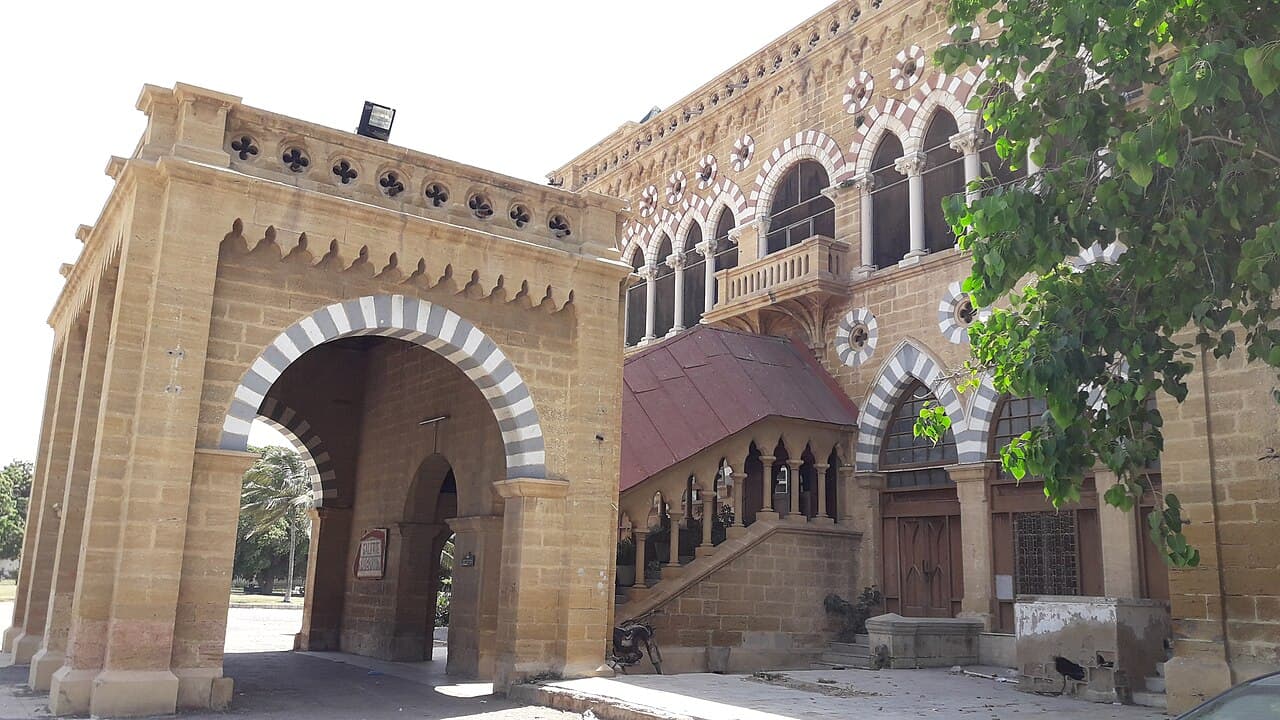
A ten-minute walk from Empress Market brings you to Frere Hall, completed in 1865 and named for Sir Henry Bartle Frere, the Commissioner of Sindh. The building is Venetian Gothic in style — unusual for a colonial building in what was then a small port city — and houses a library, gallery space, and one of Karachi's most beloved public gardens. The Sadequain murals inside the main hall are among Pakistan's great works of public art: vast, surreal calligraphic paintings by the legendary Pakistani artist covering the ceiling in a style that fuses Islamic geometry with something entirely his own. Entry is free and the murals alone justify the walk.
The gardens around Frere Hall are a sanctuary from Saddar's noise. Families picnic here on weekends, book fairs are held under the trees, and the birds that have colonised the old trees create a soundscape that briefly convinces you the city has retreated. Sit for twenty minutes before continuing.
The Parsi and Hindu Heritage of Old Saddar
Walking east from Frere Hall through the older residential lanes of Saddar, you encounter the architectural legacy of Karachi's pre-Partition population. The city before 1947 had significant Hindu and Parsi (Zoroastrian) communities who built in a hybrid style — Victorian Gothic exteriors with Indo-Saracenic details and local craftsmanship. Merewether Tower near the Custom House (accessible by a short detour toward the waterfront) is another 1880s Gothic monument worth seeing. The Zoroastrian Fire Temple on Jamshid Road still functions as a place of worship for Karachi's small remaining Parsi community.
Clifton Beach Road — Where the City Meets the Sea
The walk from Saddar to Clifton follows the logic of the city's history — from the colonial commercial centre toward the residential and recreational sea-facing districts that developed as Karachi grew. Abdullah Shah Ghazi Mazar on Clifton's hilltop is one of the most important sites on the route. The shrine of the 8th-century Sufi saint draws thousands of devotees weekly, and on Thursday evenings the qawwali performances that take place here represent a living tradition of religious music that pre-dates Islam's arrival in the subcontinent. The site overlooks the Arabian Sea, and the combination of spiritual atmosphere and sea view is genuinely moving.
The Clifton Promenade
From the shrine, descend to the Clifton seafront. The promenade along Sea View has been Karachi's recreational waterfront for over a century — photographs from the 1930s show families promenading here in much the same way they do today, the Arabian Sea unchanged behind them. The Do Darya restaurant strip at the end of the promenade provides a natural conclusion to the walk: sit at a table facing the sea, order grilled fish or prawn karahi, and watch Karachi's evening light — salt-tinged, golden, and like nothing else.
Architecture Worth Noting Along the Route
The Saddar-to-Clifton corridor preserves more colonial and early-independence era architecture than any other part of the city. Look for: the Sindh High Court building (1929, Indo-Saracenic), the State Bank of Pakistan Karachi building (1920s, neoclassical), and the various residential buildings along Napier Road and Ingle Road where Art Deco and vernacular styles intersect in ways that would be celebrated in any European city. Karachi's architectural heritage is underprotected and in places actively endangered by development pressure. This walk is partly an act of witnessing before things change further.
The total distance from Empress Market to the Clifton promenade is approximately 5 kilometres. Allow three to four hours if you intend to stop and look properly. Bring water, wear comfortable shoes, and go in the morning between October and March when the light is beautiful and the temperature is kind. This walk will not give you all of Karachi — nothing can — but it will give you its bones.