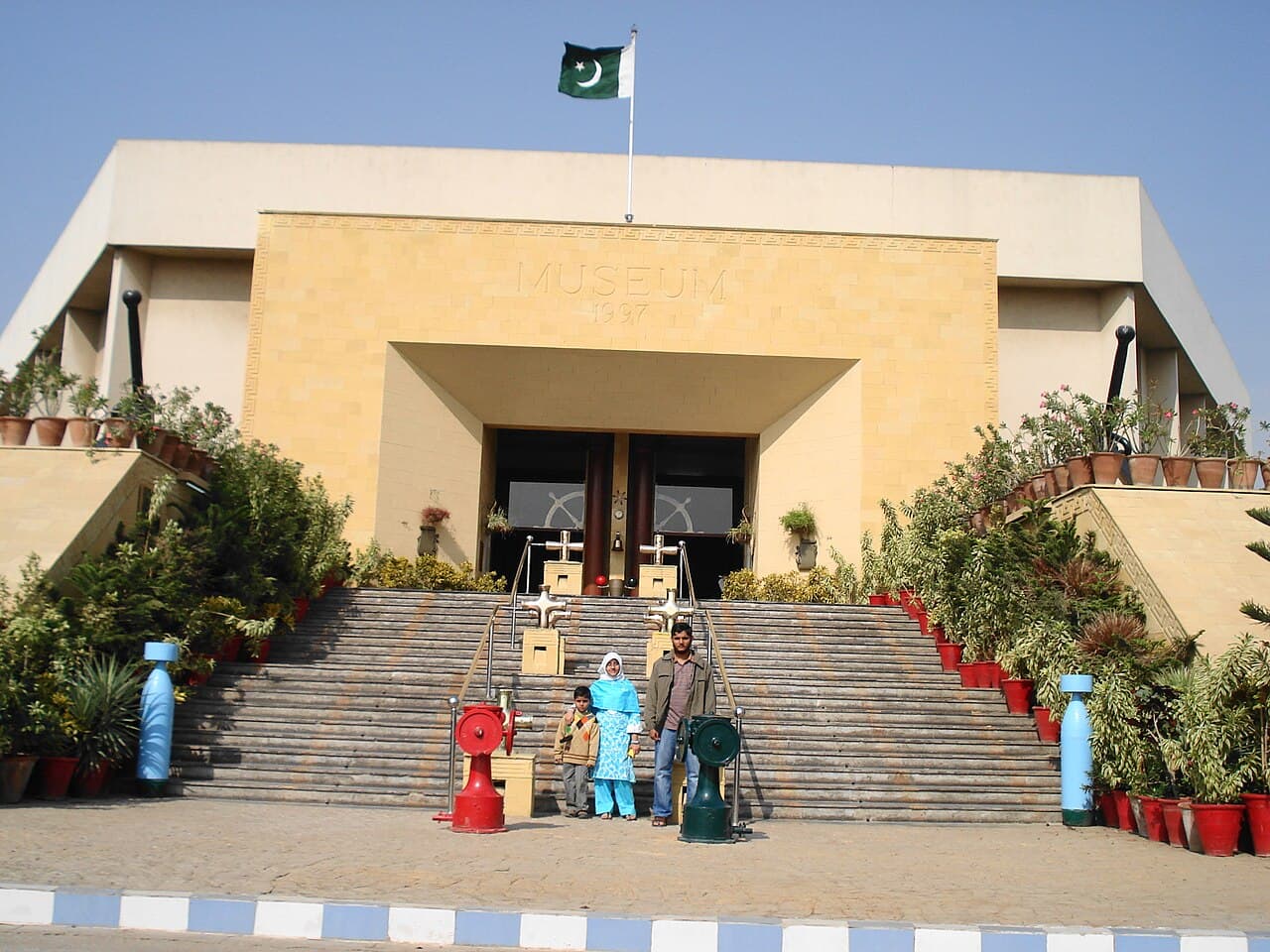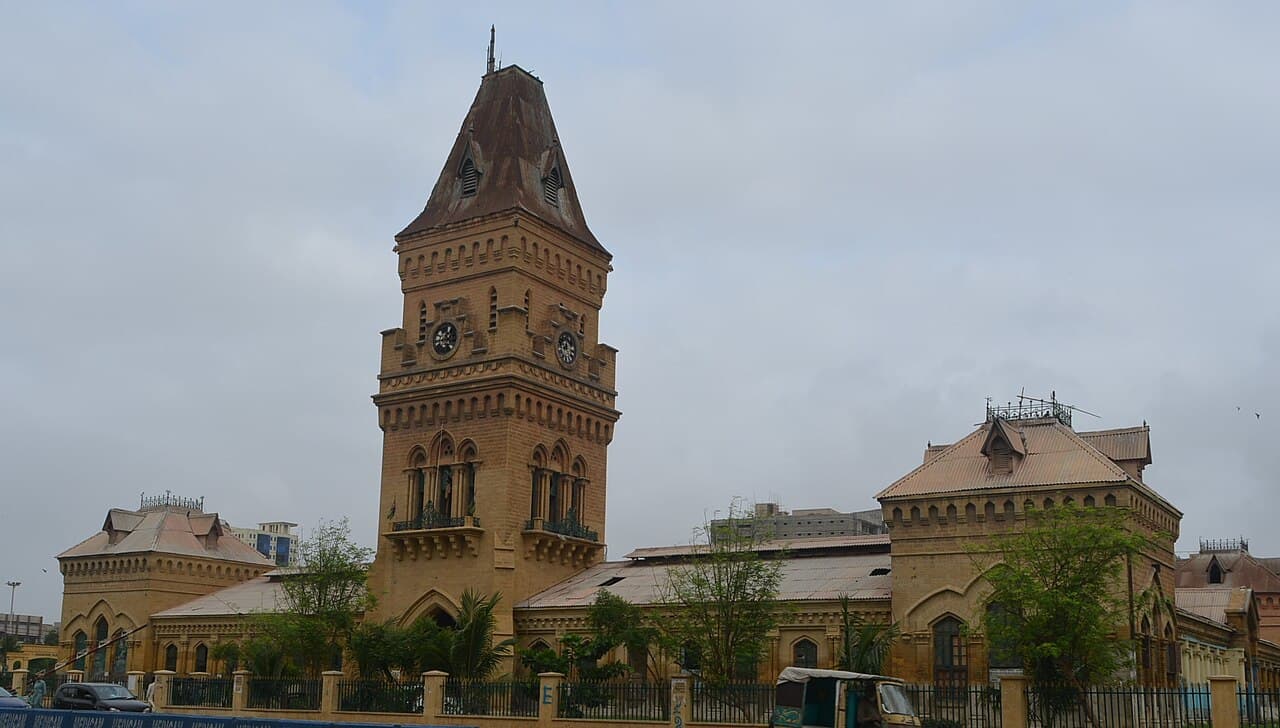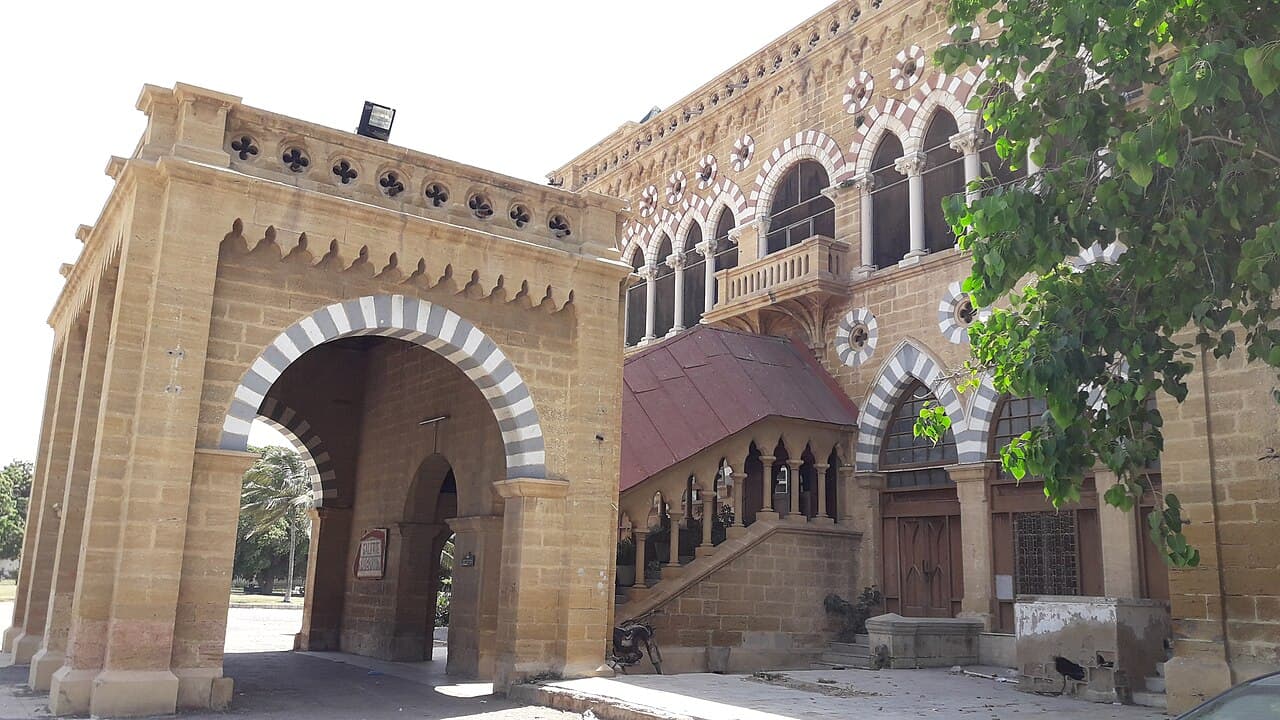
Frere Hall holds several Karachis at once: a nineteenth-century commemorative building, an exercise in imported style and local stone, the first home of Pakistan's National Museum, and a civic landmark set within a municipal garden. Those layers make it more useful as a question than as a postcard.
This feature distinguishes documented history from interpretation. It does not assume that an interior, library, exhibition or event is available today; current access must be confirmed with the responsible authority.
At a glance
Start here
- The hall's materials and verandahs adapt a formal Gothic composition to Karachi's setting.
- Its commemorative origin and later museum use represent different civic narratives.
- Bagh-e-Jinnah makes the building's public meaning spatial, not merely architectural.
- A responsible visit notices use, access and uncertainty without inventing a decline or revival story.
01
A monument began with commemoration
Sindh Antiquities says Frere Hall was constructed in 1863 to commemorate Sir Bartle Frere after he was called to the Viceroy's Council, and that its design came from Lieutenant Colonel St Clair Wilson. The federal heritage inventory classifies it as a historic building from the 1857-1947 period. This origin matters because civic monuments do political work: they place a person, administration or value into public space. A modern reader does not have to accept the original tribute uncritically. The more productive question is how later institutions and residents inherited a building whose name and form arrived through colonial government.
Sources: Directorate General of Antiquities and Archaeology, Government of Sindh; Department of Archaeology and Museums, Government of Pakistan02
Style was made from particular stone
The official descriptions call the hall Venetian Gothic and identify an octagonal tower, spire, broad verandahs, columns and arches. Sindh Antiquities describes yellowish Karachi limestone relieved by pale stone from near Bholari and red sandstone from Jungshahi; the federal entry likewise emphasises yellowish stone and gives the spire a recorded height of 44 metres. The building therefore combines a transregional style label with materials tied to the region. Look at contrast, depth and shade rather than using Gothic as a complete explanation. The verandahs and openings are not decoration alone: they mediate between monumental interior volumes and Karachi's outdoor climate.
Sources: Directorate General of Antiquities and Archaeology, Government of Sindh; Department of Archaeology and Museums, Government of Pakistan03
The garden changes how the hall is read
The open ground around Frere Hall changes how the monument can be read. Distance allows the tower to appear as part of a skyline, while closer paths make shade, verandahs and entrances more important. Civic memory often depends on this room around a monument: people may encounter a building from outside without purchasing a ticket or mastering its history. That relationship should not be romanticised or treated as an access promise. Current barriers, closures and rules remain part of the site's meaning, and visitors should confirm them before relying on a garden crossing or interior visit.
04
A national museum occupied a colonial hall
The Department of Archaeology and Museums states that the National Museum of Pakistan was established at Frere Hall in 1950, replacing the Victoria Museum, and moved to Burns Garden in 1970. That twenty-year use adds a major post-independence layer. A building created to commemorate a colonial administrator became a container for a new national collection. The shift did not erase the original architecture; it repurposed its rooms and public recognition. This is why Frere Hall resists a single-period reading. Civic institutions often work by reusing inherited structures, allowing new collections and audiences to occupy a frame whose original politics remain visible.
Sources: Department of Archaeology and Museums, Government of Pakistan05
Memory is an institutional practice
Museum memory depends on acquisition, cataloguing, conservation, display and public interpretation. The federal museum page says an advisory council was formed in 1950 to guide enrichment of the collection, while a 2026 Department of Archaeology and Museums notice describes a partnership intended to strengthen curatorial practice, public engagement and collection management at the National Museum. Although that current project concerns the museum's Burns Garden home, it clarifies what Frere Hall's earlier museum role required: not simply storing old things, but building an institution. Civic memory survives through administrative choices that are less visible than a tower yet just as consequential.
Sources: Department of Archaeology and Museums, Government of Pakistan; Department of Archaeology and Museums, Government of Pakistan06
Public use is not one thing
A garden crossing, exterior architecture study, library visit, exhibition and formal event are different kinds of public use. Do not collapse them into a claim that Frere Hall is always open or always functioning in the same way. The Antiquities page mixes historical description with generic booking widgets and support hours that even display an implausible time-zone label; those elements are not reliable evidence of current venue access. Confirm the specific interior or event with the responsible authority. If only the lawful garden and exterior are available, the building can still support a serious study of stone, shade, commemoration and urban setting.
Sources: Directorate General of Antiquities and Archaeology, Government of Sindh07
Look in four directions
Face the building and identify the formal composition. Turn toward the garden and ask how much open ground the monument seems to command. Look down at paths, thresholds and barriers to see how public approach is organised. Finally, look away toward the surrounding city and consider which newer scales, materials and traffic patterns now frame the hall. Write one documented fact and one cautious interpretation for each direction. This method keeps architecture connected to lived urban space while preventing unsupported claims about what Karachiites collectively feel. A civic landmark can be significant without an invented consensus, and memory can be contested without turning every visit into a slogan.
Useful answers
Reader questions
When was Frere Hall built?
Sindh Antiquities records construction in 1863, while federal inventory data places it within the broader 1857-1947 historic period.
Sources: Directorate General of Antiquities and Archaeology, Government of Sindh; Department of Archaeology and Museums, Government of PakistanWhat architectural style is it?
The official descriptions call it Venetian Gothic and identify an octagonal tower, spire, verandahs, arches and contrasting stone.
Sources: Directorate General of Antiquities and Archaeology, Government of Sindh; Department of Archaeology and Museums, Government of PakistanWas the National Museum located there?
Yes. The Department of Archaeology and Museums says the National Museum began at Frere Hall in 1950 and moved to Burns Garden in 1970.
Sources: Department of Archaeology and Museums, Government of PakistanCan I assume the hall interior is open?
No. Confirm the exact interior, library or event directly. Historical pages are useful for facts about the building, not a dependable live access feed.
Sources:Read the evidence
Sources and further reading
These sources support the relevant sections above. Plans and comparisons are editorial suggestions. Check operators for current arrangements.
- Frere Hall, Karachi ↗Directorate General of Antiquities and Archaeology, Government of Sindh · Accessed 14 September 2026
Construction date, commemorative purpose, design attribution, style, materials and form.
- Frere Hall ↗Department of Archaeology and Museums, Government of Pakistan · Accessed 14 September 2026
Federal inventory classification, protected status, form and recorded dimensions.
- National Museum of Pakistan, Karachi ↗Department of Archaeology and Museums, Government of Pakistan · Accessed 14 September 2026
The National Museum's establishment at Frere Hall in 1950 and relocation in 1970.
- News ↗Department of Archaeology and Museums, Government of Pakistan · Accessed 14 September 2026
The 2026 partnership concerning curatorial practice, public engagement and collection management at the National Museum.