Karachi's historic buildings make more sense as clusters than as a single heroic walking trail. Civil Lines, the old Bunder Road corridor and Kharadar hold different building types, street conditions and public histories. This route uses three segments and makes the third optional, so architecture remains the subject instead of traffic between photo stops.
The official records establish dates, materials, names and protected status, but not today's interior access or walking conditions. Confirm every entrance directly, observe private property from public ground and never enter a doorway, stair or courtyard merely because a building appears on a heritage list.
At a glance
Start here
- Begin around Frere Hall and Flag Staff House for stone, gardens and civic scale.
- Use Khaliq Dina Hall to read the link between public meetings and libraries.
- Treat Kharadar and Wazir Mansion as an optional third segment.
- Look for material, shade, frontage and reuse rather than collecting façade photographs.
01
Treat the route as three segments
Segment one joins Frere Hall and Quaid-e-Azam House Museum in the wider Civil Lines and Staff Lines area. Segment two shifts to Khaliq Dina Hall on the historic Bunder Road corridor, now M.A. Jinnah Road. Segment three enters Kharadar for Wazir Mansion. Sindh Antiquities organises heritage notifications by quarters including Civil Lines, Bunder, Market, Saddar Bazaar and Old Clifton. Those official categories justify a clustered reading, not a claim that sidewalks or direct connections are continuously comfortable. Use a vehicle between segments when current conditions require it and save the exact lawful drop-off point. Each building's individual record supplies its history; the quarter list supplies only geography.
Sources: Directorate General of Antiquities and Archaeology, Government of Sindh02
Begin with Frere Hall's material lesson
Frere Hall provides a clear first exercise because the official description names both style and fabric. Built in 1863 to a design by Lieutenant Colonel St Clair Wilson, it is described as Venetian Gothic, with an octagonal tower, broad verandahs and contrasting yellowish Karachi limestone, white stone and red sandstone. Walk only where current public access permits and compare the tower's vertical emphasis with the verandahs' shade and horizontal rhythm. Step back far enough to see the relationship between the formal hall, planted ground and surrounding streets. The lesson is not that every old stone building is Gothic; it is that materials, openings and setting must be read together.
Sources: Directorate General of Antiquities and Archaeology, Government of Sindh03
Compare a residence with a civic hall
Quaid-e-Azam House Museum, commonly called Flag Staff House, changes the scale from public hall to residence. Sindh Antiquities places the yellow-stone, double-storey building at Shahrah-e-Faisal and Fatima Jinnah Road and records Muhammad Ali Jinnah's purchase of it in 1943 from Sorab Kavasji Katrak, a former mayor. If the museum is open, read how rooms and circulation shape a biographical display; if it is closed, do not improvise access. From lawful public ground, compare boundary, garden setback, stone and openings with Frere Hall. The official page carries old visitor information, so verify current arrangements rather than copying its displayed hours or fees.
Sources: Directorate General of Antiquities and Archaeology, Government of Sindh04
Look for public purpose at Khaliq Dina Hall
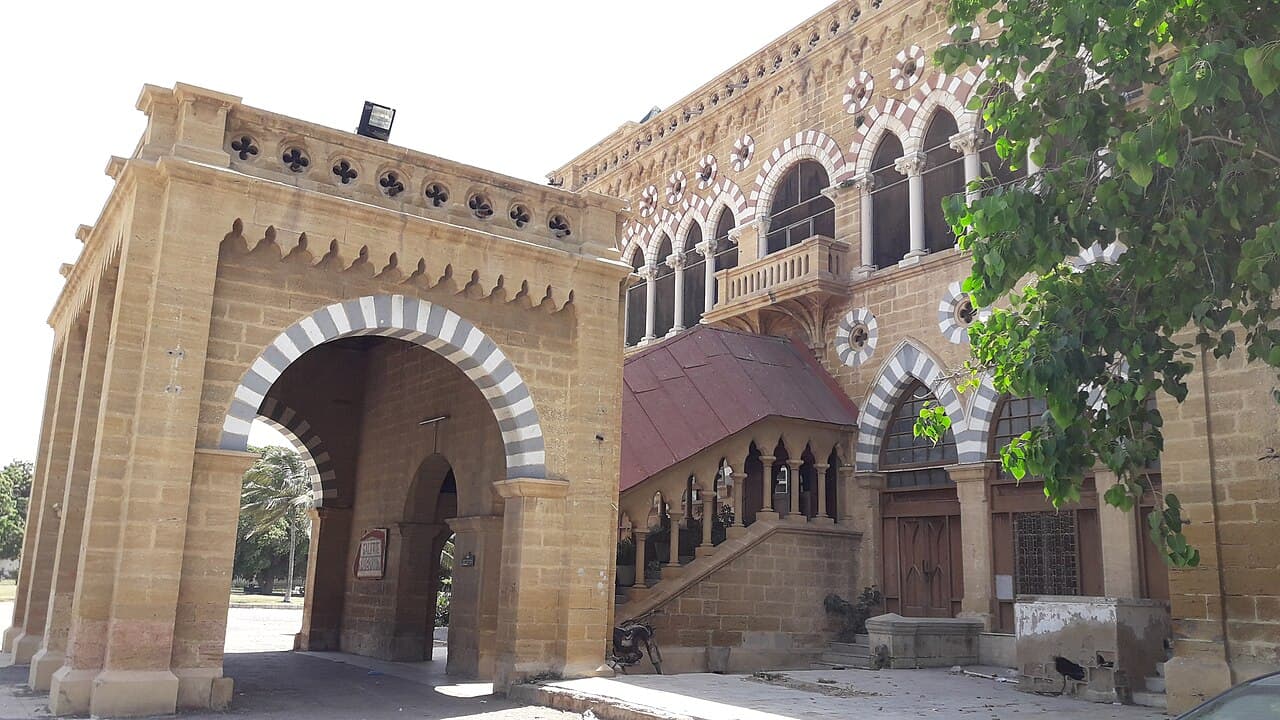
Khaliq Dina Hall makes public purpose visible in a different way. The Department of Archaeology and Museums dates it to 1906 and describes a spacious hall for public meetings, additional rooms, a public library, ashlar masonry and a wooden roof. Read the façade by asking how a meeting hall announces entry, how the additional rooms relate to the main volume and what the stonework communicates about durability. Do not turn the historic meeting function into a claim about present capacity, and do not infer interior condition or access from the protected-building record. Its value on this route is the documented union of assembly and reading.
Sources: Department of Archaeology and Museums, Government of Pakistan05
Read the corridor, not only icons
The official heritage catalogue for the Artillery Maidan quarter names modestly documented buildings such as Anees Manzil, Nizam Mansion, Ayesha Mansion, Bombay Wala Mansion and Mehdi Building along Mohammad Bin Qasim Road and Shahrah-e-Liaquat. Their inclusion matters because a historic district is not composed only of famous monuments. From public space, look for repeated plot widths, balconies, corner treatments, shopfront changes, patched stone and new services attached to old fabric. Do not assign a date, community or architect where the official record supplies none. A useful route distinguishes observed physical evidence from interpretation and keeps unidentified buildings unidentified.
Sources: Directorate General of Antiquities and Archaeology, Government of Sindh06
Make Kharadar the optional segment
Wazir Mansion adds Kharadar and a second form of domestic memory. The federal heritage page identifies it as the Quaid-i-Azam Birthplace Museum, describes stone masonry in lime and jute mortar, and places it in Kharadar. The Sindh catalogue also lists it as a heritage building and museum. Because reaching a dense commercial district can consume the time saved elsewhere, decide before leaving Khaliq Dina Hall whether the group still has attention for careful looking. Confirm museum status and drop-off arrangements. If conditions are poor, end the route without treating Kharadar as a box that must be ticked.
Sources: Department of Archaeology and Museums, Government of Pakistan07
Record change without inventing decline
For each stop, note documented purpose, present visible use, material, one alteration and one uncertainty. A blocked opening or new sign may indicate adaptation, maintenance or neglect; appearance alone cannot tell you which. Photograph only from permitted locations and avoid faces, interiors or security details without permission. End by comparing the public meeting hall, residence, museum and garden as civic types. This produces a more honest record than declaring that every old building has been forgotten or beautifully restored. Heritage is an administrative status, a physical fabric and a changing use; those three layers can align, but the route should not assume that they do.
- Document what the official record says.
- Separate what you see from what you infer.
- Mark access, condition and use as uncertain when not verified.
Useful answers
Reader questions
Is this entire route walkable?
It should not be treated as one continuous walk. Use three clusters and decide each transfer from current traffic, street, heat and mobility conditions.
Sources:Which stop should I drop first?
Drop Kharadar first if time or energy is limited because it is the optional third segment. Preserve Frere Hall and one public-building comparison.
Sources:Why is Khaliq Dina Hall important?
The federal record describes it as a 1906 public meeting hall with rooms used for a public library, giving the route a civic function beyond residences and monuments.
Sources: Department of Archaeology and Museums, Government of PakistanDoes heritage listing mean I can enter?
No. Listing or protection does not establish current public access. Confirm with the responsible institution and observe private or closed property only from lawful public ground.
Sources:Read the evidence
Sources and further reading
These sources support the relevant sections above. Plans and comparisons are editorial suggestions. Check operators for current arrangements.
- Frere Hall, Karachi ↗Directorate General of Antiquities and Archaeology, Government of Sindh · Accessed 14 September 2026
Frere Hall's date, architect, style, materials and main features.
- QUAID-E-AZAM HOUSE MUSEUM, KARACHI ↗Directorate General of Antiquities and Archaeology, Government of Sindh · Accessed 14 September 2026
Flag Staff House's location, form and acquisition history.
- Khaliq Dina Hall and Library ↗Department of Archaeology and Museums, Government of Pakistan · Accessed 14 September 2026
The hall's 1906 date, public meeting and library functions, construction and protected status.
- Artillery Maidan Quarter ↗Directorate General of Antiquities and Archaeology, Government of Sindh · Accessed 14 September 2026
Names and catalogue locations of multiple heritage buildings in the quarter.
- Wazir Mansion, Karachi ↗Department of Archaeology and Museums, Government of Pakistan · Accessed 14 September 2026
Wazir Mansion's museum identity, Kharadar location and described masonry.
- Notification ↗Directorate General of Antiquities and Archaeology, Government of Sindh · Accessed 14 September 2026
Official organisation of heritage notifications by Karachi quarter.